Tests for gases
The four gas tests as a reference table, gas, test and positive result, ready for the board in one click. Sized for projection and exportable for a worksheet.
A hand-built replica of the real builder page, not a screenshot. Every control shown exists in the product.
Part of the Science table family. See Bond energies table, Flame test colours and Tests for negative ions pages to explore further.
Why this works in Chemistry
Two of the four use a splint, and that is where the marks go. Hydrogen needs a burning splint and gives a pop, oxygen needs a glowing splint and relights it, and pupils swap them because both sound right. With the rows together the class sees that the test and the result are a pair.
Clear the result column and the class writes each result before you show the full table, then send it to Stimulus Questions for exam style questions about the same four gases.
Tests for gases, filled in and blank
Every image here is free to use in your teaching under our image licence.
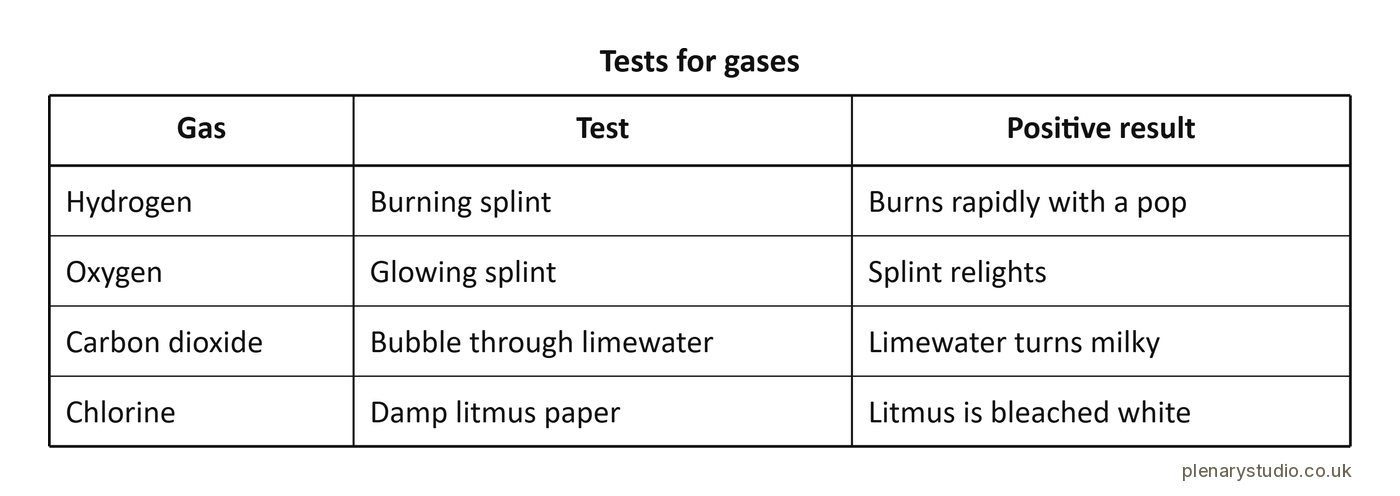
The four gas tests, each with the test and the result that confirms the gas.Download image, The four gas tests, each with the test and the result that confirms the gas. 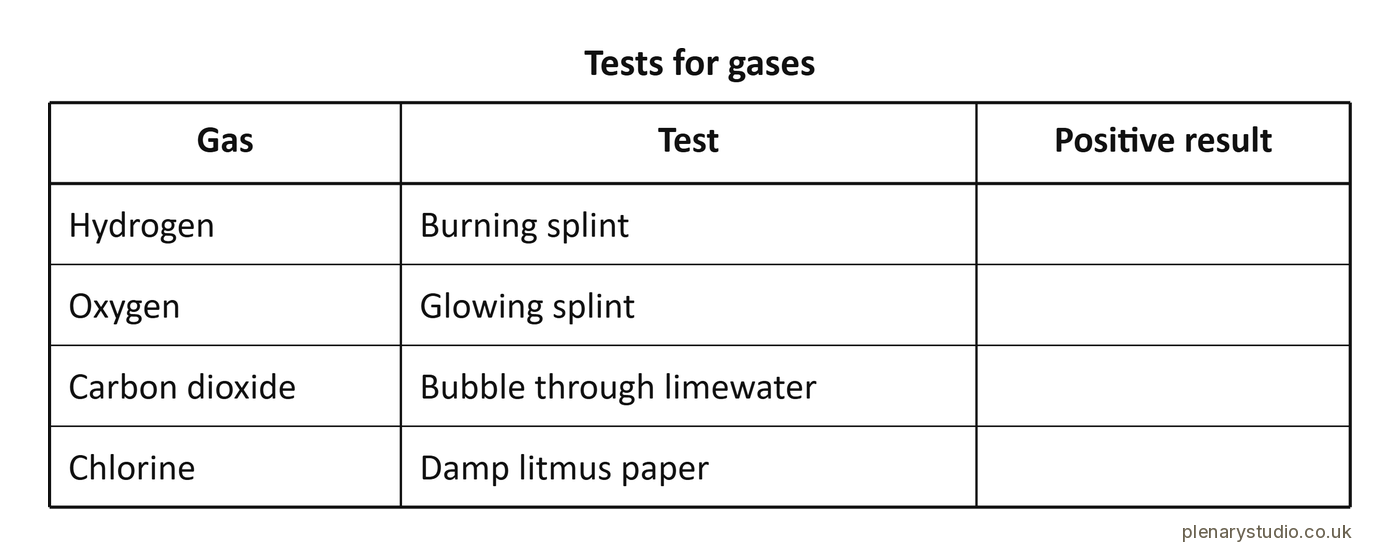
The gas tests with the results left blank, for pupils to fill in.Download image, The gas tests with the results left blank, for pupils to fill in.
More Chemistry resources
Multiple choice questions
Diagnostic multiple choice. Each answer reveals what the class does and doesn't understand.
Random number match
Click a number and watch it land on a question at random. Built for cold-call questioning.
Memorise and recall
Automate show, cover, and recall tasks. Great for memorising diagram features or keywords.
Stimulus questions
Questions beside a visual stimulus. A YouTube clip, diagram, graph, or a paragraph to read closely.
Electron configuration
Shell diagrams for atoms and ions, with dots or crosses, hidden electrons and side-by-side comparison.
Bonding diagram
Dot-and-cross diagrams for ionic and covalent bonding, with a stepped build-up, hidden electrons and labels.
Chemistry equation
Curated, balanced GCSE reaction equations, ready to blank for recall.
Chemistry calculation
Generate chemistry calculations with scaffolded, worked solutions.
Visual tools
Every tool turns a few inputs into a clean, exam-ready diagram.
Science table
Practical results tables with repeat readings, a mean and an optional anomaly, plus curated reference data.
Bond energies table
A bond energies table beside the balanced equation, with the structures drawn so pupils can count bonds.
Flame test colours
The flame colour each metal ion gives, as a reference table for the board in one click.
Tests for negative ions
The reagent and positive result for the carbonate, halide and sulfate ions.
Diagram labeller
Upload any diagram and the labels are suggested for you to drag, edit and blank.
Teach with us
and start building.
Plenary Studio is open to every UK secondary teacher. Sign up free, no card details, and build your first resource in minutes. Join the new wave of teachers bringing Plenary Studio into their classroom.
One inbox, no marketing list. We read every email.
Say hello.
We’d love to hear from teachers, heads of department, and anyone curious about where this is going.
hello@plenarystudio.co.ukOpens your email client. Nothing is sent to us until you press send there.