Velocity time graphs
The graph builder draws GCSE standard velocity-time graphs in one click, a car braking, constant and changing acceleration, a skydiver reaching terminal velocity. Edit the journey points or use the fixed curves, then present or download.
A hand-built replica of the real builder page, not a screenshot. Every control shown exists in the product.
Part of the Graph builder family. See Half life graphs, IV characteristic graphs, Infrared radiation graphs and Distance time graphs pages to explore further.
Why this works in Physics
The graph above displays stopping distance, but the scenario list covers the whole specification. Sketching velocity-time graphs is easy. They are useful for questioning and recognising correct shapes. However, familiarising your class with exam paper standard graphs, and teaching them how to extract and use the data they display has more value than a setched graph.
Velocity time graphs for three journeys
Every image here is free to use in your teaching under our image licence.
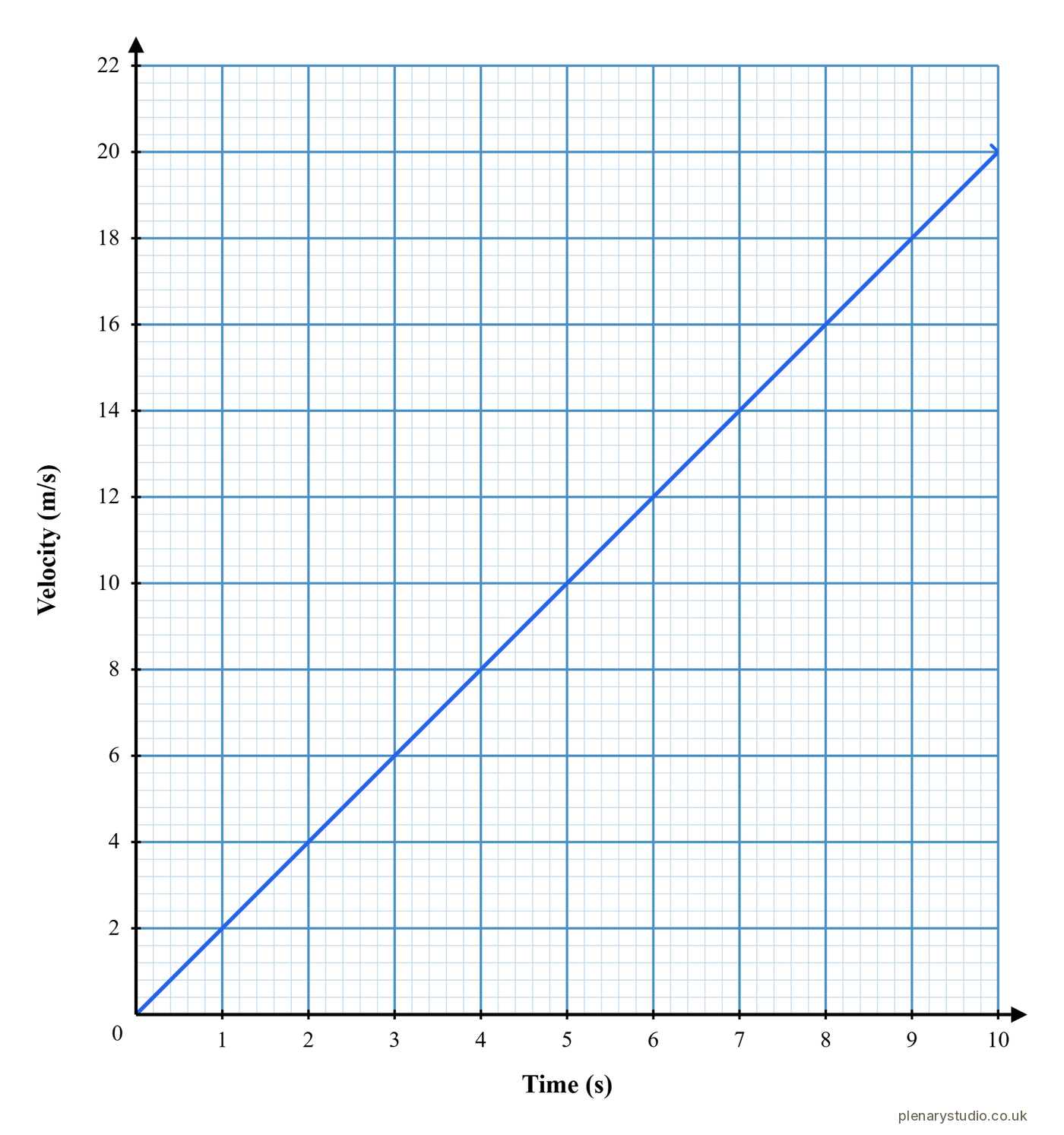
Constant acceleration, a straight line whose gradient is the acceleration.Download image, Constant acceleration, a straight line whose gradient is the acceleration. 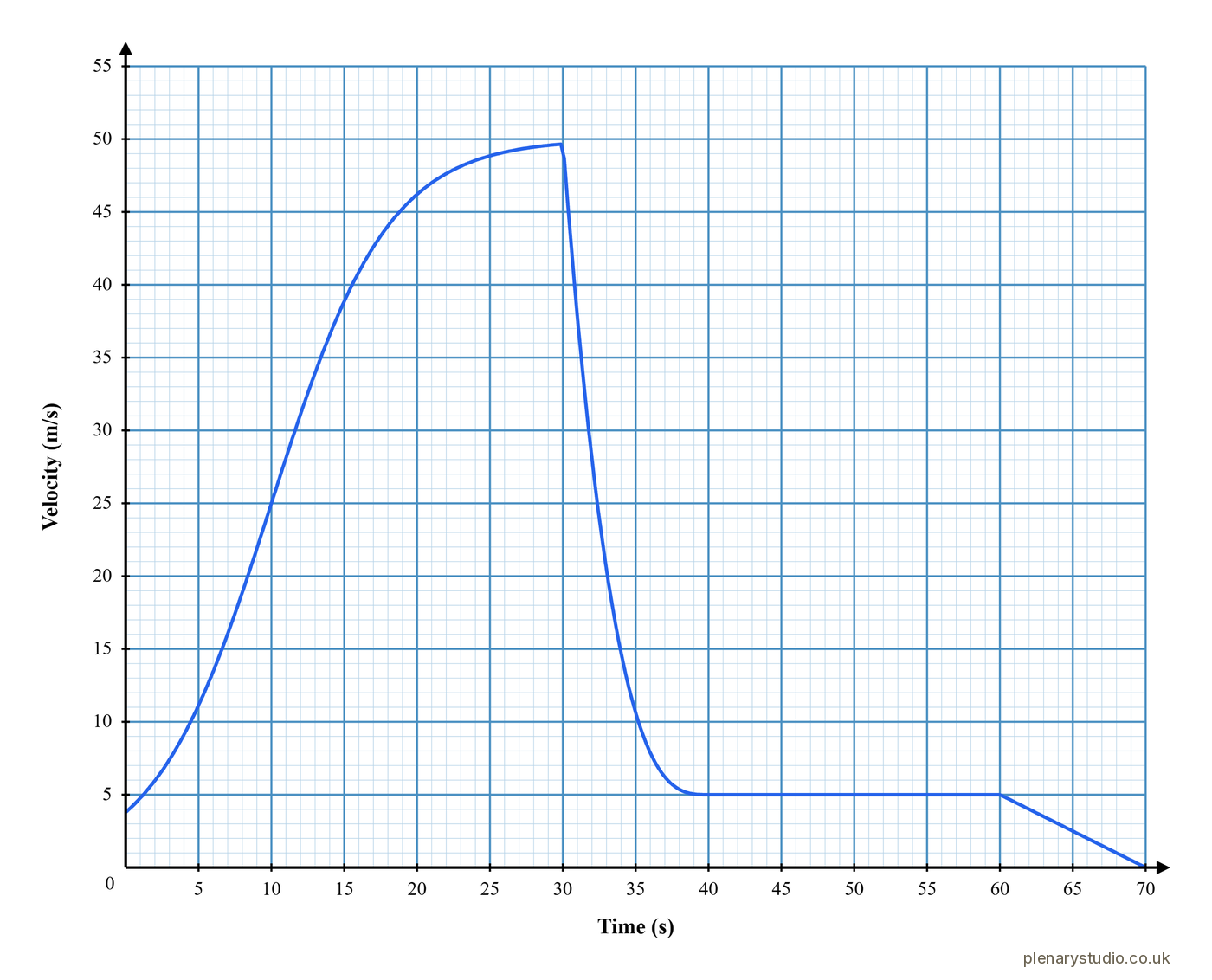
A skydiver reaching terminal velocity, then slowing to a lower one once the parachute opens.Download image, A skydiver reaching terminal velocity, then slowing to a lower one once the parachute opens. 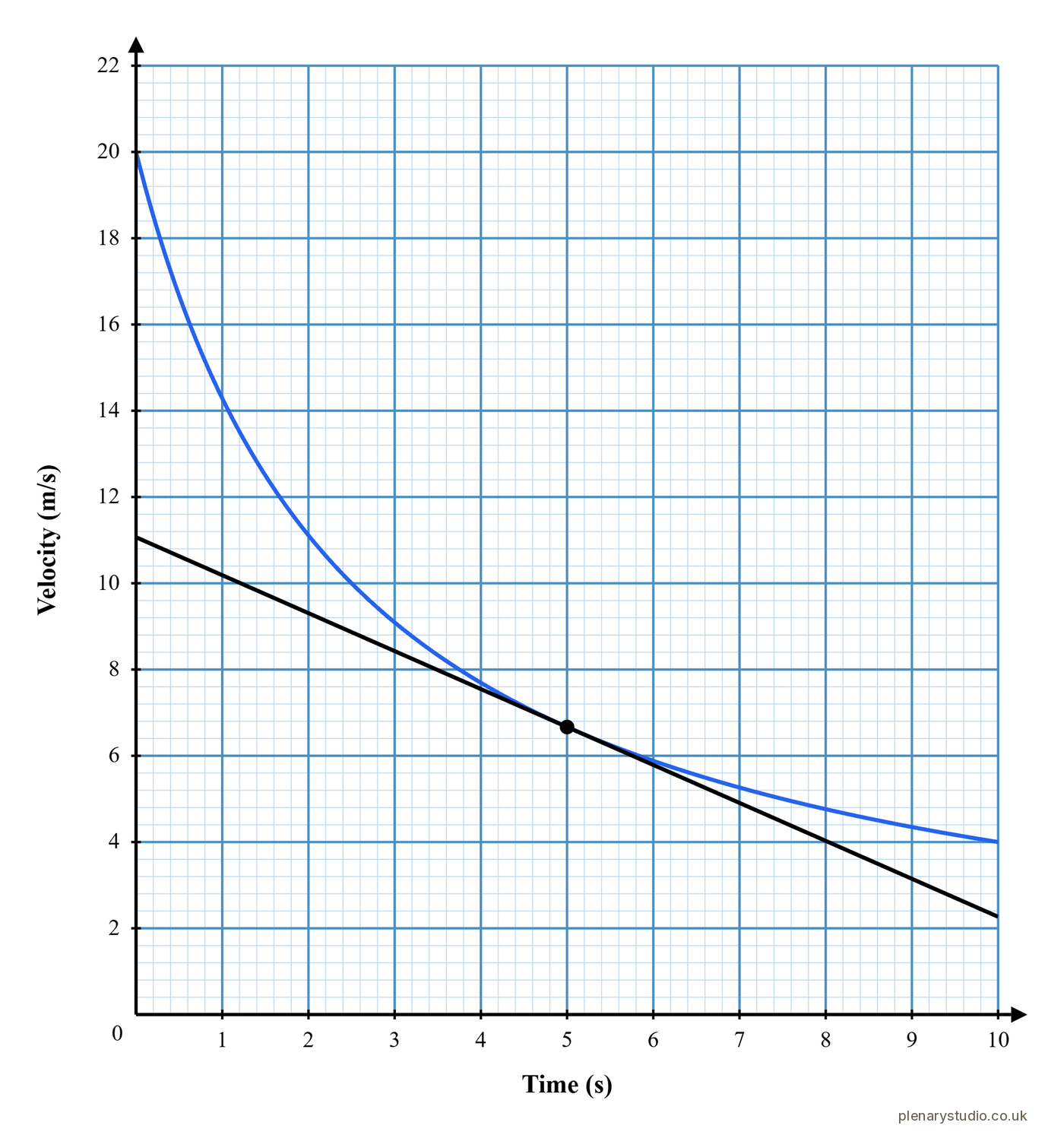
A tangent on a curved velocity time graph gives the acceleration at that instant.Download image, A tangent on a curved velocity time graph gives the acceleration at that instant.
More Physics resources
Multiple choice questions
Diagnostic multiple choice. Each answer reveals what the class does and doesn't understand.
Click to reveal
Answers revealed when you click. Great for starters or extension questions.
Keyword matching
Match keywords to their definitions. Great for prior learning or end-of-lesson review.
Visual tools
Every tool turns a few inputs into a clean, exam-ready diagram.
Half life graphs
Decay curves for real isotopes with the half life read off a dashed construction line.
IV characteristic graphs
Ohmic conductor, filament lamp and diode on symmetric axes, the required practical graphs in one click.
Infrared radiation graphs
Heating to equilibrium and cooling curves for matt black, matt white and shiny silver surfaces.
Distance time graphs
Journeys you edit point by point on GCSE graph paper, with a tangent tool that reads the speed off the gradient.
Equation builder
Equation selection, rearrangement and substitution practice, step by step.
Forces builder
Free-body diagrams, resolve into components, find the resultant on GCSE graph paper.
Momentum builder
Before and after collision diagrams with selectable unknowns and a step-by-step reveal.
Ray diagrams (lenses)
Graph-paper lens, focal points and object for teaching ray construction.
Radiation equation
Curated GCSE nuclear equations covering alpha, beta, fission, fusion and decay chains.
Circuit diagrams
Build circuits from standard GCSE symbols and components.
Science table
Practical results tables with repeat readings, a mean and an optional anomaly, plus curated reference data.
Diagram labeller
Upload any diagram and the labels are suggested for you to drag, edit and blank.
Teach with us
and start building.
Plenary Studio is open to every UK secondary teacher. Sign up free, no card details, and build your first resource in minutes. Join the new wave of teachers bringing Plenary Studio into their classroom.
One inbox, no marketing list. We read every email.
Say hello.
We’d love to hear from teachers, heads of department, and anyone curious about where this is going.
hello@plenarystudio.co.ukOpens your email client. Nothing is sent to us until you press send there.